
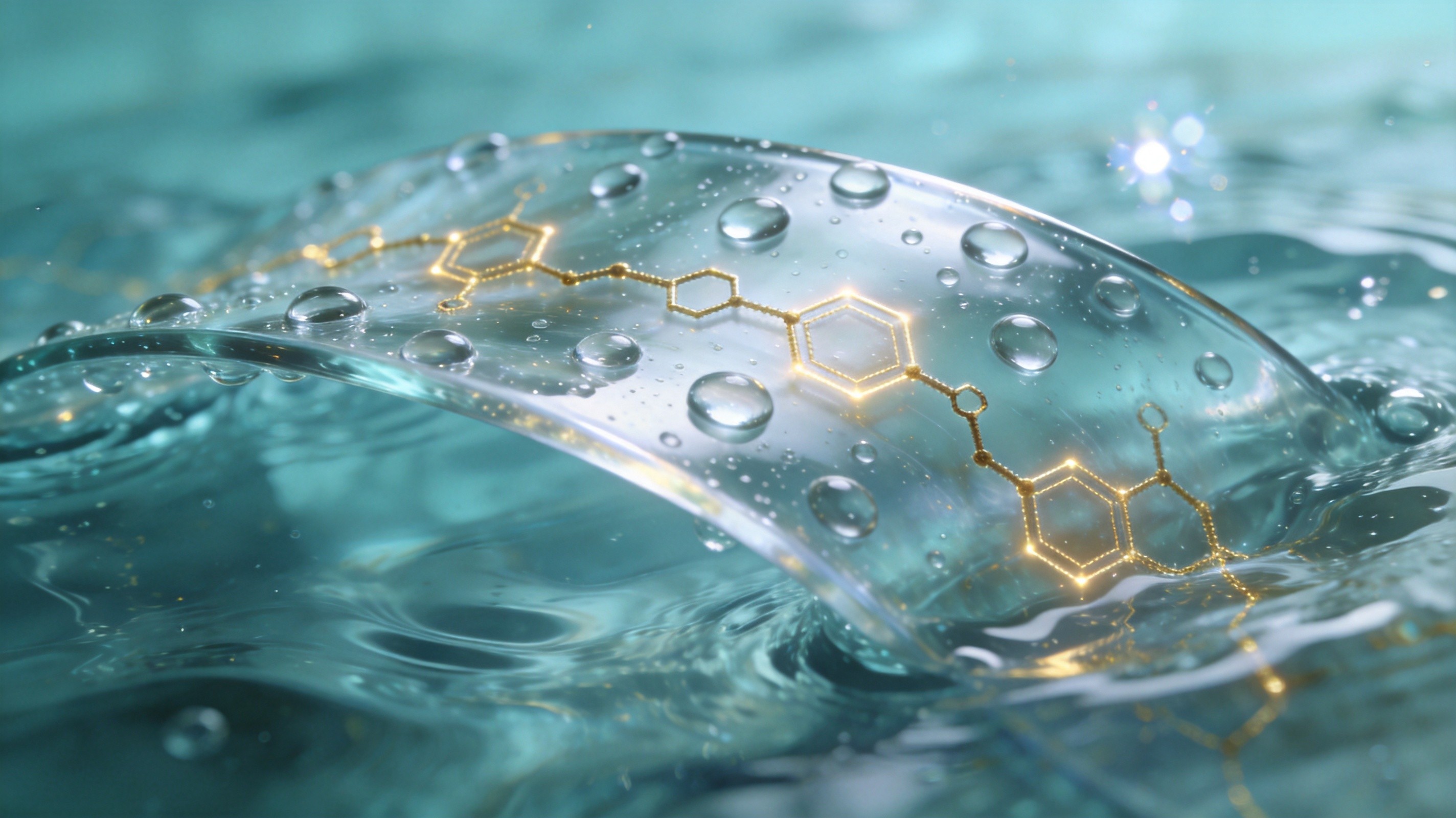
Mussel Adhesive Protein (MAP) forms a highly adhesive and breathable protective film on wet surfaces containing water, grease or dynamic friction through its unique DOPA residues. It is currently the core biological raw material to solve the problem of water-soluble film-forming agents easily falling off in the wet state.
Traditional film-forming agents perform well on dry skin, but when exposed to sweat, sebum, or exudate from medical aesthetic wounds, the film layer easily breaks and falls off. Formulators pay attention to MAP because of its bionic wet-stick mechanism. Mussels can cling tightly to rocks under the impact of waves because of the DOPA (3,4-dihydroxyphenylalanine) in their bodies. DOPA can form hydrogen bonds and coordination bonds with inorganic or organic surfaces, and can also undergo cross-linking reactions on its own.
In formulation systems, MAP exhibits several key physical properties:
Wet surface adhesion: The surface does not need to be absolutely dry. In a relative humidity of more than 80% or in a pure water environment, MAP can still maintain stable adhesion and will not slip when exposed to water like ordinary polymers.
Breathable film-forming: It does not form a closed plastic film, but a reticular hydration film. This structure allows water vapor to pass through, does not feel stuffy on the skin, and does not hinder the normal ventilation needs of the wound.
Anti-friction and appearance improvement: The film layer is microscopically elastic and resistant to daily touch. After film formation, a soft matte feeling will be formed on the skin surface, visually helping the skin texture to look smoother.
Application scenarios and complex configuration logic
In the fields of medical aesthetics and devices, MAP is often used for wound protection after photoelectric surgery or microneedling. It itself does not provide direct cell repair signals, and its strength lies in "covering the quilt". Combining it with recombinant humanized collagen Type III or fibronectin, MAP is responsible for forming a breathable protective layer on the moist wound surface, fixing the active ingredients at the site of action, and reducing loss.
In high-end skin care, MAP is used in anti-friction and anti-pollution formulations. Used after sunscreen or makeup base, it can reduce makeup loss and the adhesion of external particles on the skin surface.
There is a pitfall that must be avoided when formulating: pH and oxidation. The DOPA group is easily oxidized under alkaline conditions. If the pH value of the formula is too high, the material will quickly turn pink or even brown. It is recommended to strictly control the pH value of the formula between 4.0 and 6.5. At the same time, avoid direct mixing with strong oxidants or high concentrations of heavy metal ions (such as copper and iron). Excessive metal ions in the water source will also cause discoloration.
Q: What is the INCI name of mussel mucin? A: Cosmetic raw materials are usually registered as Hydrolyzed Conchiolin Protein or Hydrolyzed Mussel Protein. In the field of medical devices or scientific research, it is directly referred to as Mussel Adhesive Protein. When filing, formulators need to declare based on the INCI certificate provided by the specific raw material supplier.
Q: Why does MAP change color in the formula? A: The discoloration is due to the oxidation of the DOPA group. When the pH value of dopa is higher than 7.0 or when it comes into contact with heavy metal ions, it is easily oxidized into quinone substances, causing the material to turn brown. Strictly controlling the pH value of the formula between 4.0 and 6.5 and avoiding the use of water sources containing copper and iron ions can effectively prevent discoloration.
Q: Can mussel mucin be compounded with other active substances? A: Absolutely, and the synergy is very good. MAP itself does not provide direct cell repair signals. Its strengths are film formation and adhesion promotion. Combining it with recombinant type III humanized collagen or fibronectin, MAP can form a breathable protective layer on the skin surface to help the active ingredients stay better at the site of action.
Q: What is the difference between medical grade MAP and cosmetic grade MAP? A: The core differences are purity, endotoxin control and sterilization process. Medical-grade MAP is used for wound dressings or tissue adhesion and needs to meet strict sterility and low endotoxin standards. It is usually in the form of lyophilized powder or specific hydrogel. Cosmetic grade focuses on sensory experience, film-forming skin feel and antiseptic system, and is mostly liquid raw materials.Q: How much should be added to achieve the ideal film-forming effect? A: In conventional water or essence formulas, the effective solid content is usually between 0.1% and 2.0% to form a continuous microscopic protective film. The specific amount added depends on the proportion of thickener and oil in the formula and the skin feel requirements of the target product. It is recommended to start gradient testing from 0.5%.