
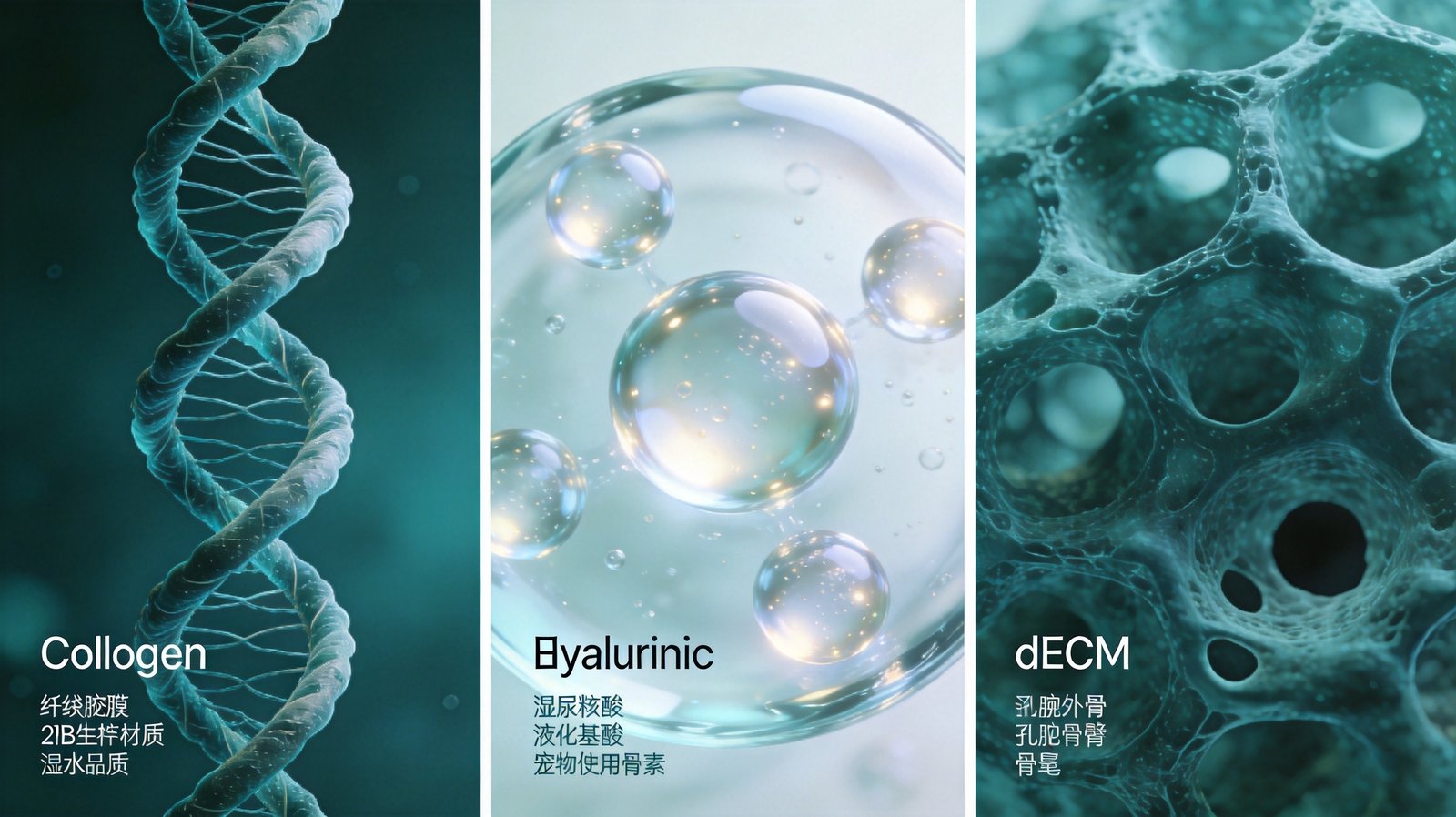
I. What Are the Three: Differences in Molecular Essence
Collagen, hyaluronic acid (HA), and decellularized ECM (dECM) are often compared together, but their molecular essences are completely different. Only by clarifying this point can we understand all the subsequent mechanisms and data.
Collagen is a structural protein. It is the most abundant structural protein in the human body and also the protein with the highest proportion in the extracellular matrix (ECM). Its molecule is based on the repeating "glycine-X-Y" tripeptide as the basic unit, and three peptide chains twist into a triple superhelix structure, giving skin, bone, and tendon tension and support. More than 28 types of collagen are currently known. In skin, type I and type III account for the highest proportions, and in recent years "niche types" such as type XVII have also been repeatedly mentioned due to anti-aging research.
Hyaluronic acid is a glycosaminoglycan (GAG). It is formed by alternating connections of D-glucuronic acid and N-acetylglucosamine. It is the only glycosaminoglycan that does not contain sulfate groups. Its molecule is a linear polysaccharide chain, widely distributed in the dermis of the skin, synovial fluid of joints, and vitreous body of the eye. It is the "filling and hydration" molecule in the ECM. Since its discovery from bovine vitreous body in the 1930s, HA has gone through two technological eras: animal extraction and microbial fermentation, and has now become one of the most mature bioactive ingredients in application.
dECM is a natural ECM complex after decellularization. It removes cellular components from tissues through physical, chemical, or enzymatic methods, retaining collagen, elastin, glycosaminoglycan, proteoglycan, and multiple growth factors. It is a full-component biomimetic system that "removes cells and retains matrix." Decellularization technology originated in the field of tissue engineering and has only gradually migrated to medical aesthetics and skincare scenarios in recent years, which is also why dECM currently has the lowest awareness but the greatest growth potential.
To summarize the relationship among the three in one sentence: collagen is the "rebar" of the ECM, HA is the "sponge" of the ECM, and dECM is the "entire house."
II. Molecular-Level Comparison: Molecular Weight, Structure, and Function
| Dimension | Collagen | Hyaluronic Acid (HA) | dECM |
|---|---|---|---|
| Category | Structural protein (mainly type I/III) | Glycosaminoglycan (non-sulfated) | Natural ECM complex |
| Molecular weight | Triple-helix monomer about 300 kDa | Adjustable from 1 kDa–8000 kDa | No single molecular weight |
| Molecular structure | Triple superhelical fiber | Linear disaccharide repeating polysaccharide chain | Three-dimensional natural network + proteoglycan |
| Core function | Structural support + signal transduction | Moisturizing hydration + volume filling | Biomimetic microenvironment + tissue reconstruction |
Collagen's triple-helix structure determines its "support" attribute, while the molecule also carries signaling fragments such as integrin-binding sites; HA, with its large number of hydroxyl and carboxyl groups, can bind up to a thousand times its own weight in water and is recognized as the main natural moisturizing force; dECM simultaneously provides a structural scaffold, biological signals, and a growth factor reservoir, making it the system with the greatest amount of information among the three.
What formulators should note is that collagen and HA are both "single molecules," and their molecular weights can be precisely regulated (HA from low molecular weight to high molecular weight, collagen from intact triple helix to hydrolyzed peptides), with relatively clear efficacy and transdermal strategies; while dECM is a "complex system" with no standard molecular weight, and its evaluation dimensions are more complex, but because of this it is also harder to imitate and easier to establish barriers. From the molecular level, "collagen vs hyaluronic acid" is a comparison of like with like, while "dECM vs collagen" is an asymmetric comparison of "system vs monomer."
III. Comparison of Mechanisms of Action
Collagen: structural support + signal peptide activation. Collagen forms a fiber network in the skin and directly provides mechanical support; specific amino acid sequences on its molecule (such as integrin recognition sites like GFOGER) can be recognized by skin cells, inducing fibroblast adhesion, migration, and new matrix synthesis—this is precisely the source of the mechanism by which "collagen promotes self-generated collagen." Recombinant collagen is expressed through genetic engineering to produce human-derived sequences, avoiding the immunogenicity controversy of animal-derived ingredients while further strengthening the above signaling pathways.
HA: moisturizing + volume filling + hydration signaling. HA's water-locking ability directly improves skin hydration; cross-linked HA has injectable volume-filling capability and is currently the mainstream global medical aesthetics dermal filler; at the same time, HA transmits "hydration environment" signals to cells through receptors such as CD44, regulating cell proliferation, migration, and inflammatory responses, and participating in tissue repair. Low-molecular-weight HA also has transdermal penetration advantages, which is also the molecular basis for the logic of oral and topical HA.
dECM: full-component biomimicry + tissue microenvironment reconstruction. dECM is not a single ingredient, but rather "packages and restores" collagen, GAG, elastin, growth factors, and others into a microenvironment close to the real state in vivo. When applied to skin and tissues, it provides host cells with a trinity of regenerative conditions: "scaffold + signal + reserve," achieving microenvironment reconstruction through in situ induction, with a level of action closer to the "source" than any single ingredient.
To compare the mechanisms of the three in one sentence: collagen "provides structure and issues instructions," HA "locks in water and props up volume," and dECM "rebuilds the home and recruits cells."
IV. Comparison of Application Scenarios
| Application scenario | Collagen | Hyaluronic Acid (HA) | dECM |
|---|---|---|---|
| Cosmetics | Hydrolyzed collagen/recombinant collagen: firming and anti-wrinkle, barrier maintenance | Classic moisturizer: hydration and moisture retention | ECM skincare concept: micronized ECM added, focusing on "microenvironment repair" |
| Oral | Collagen peptides: bone, skin, and joint beauty | Oral HA: moisturizing and joint/skin care | Less common, appearing in the form of collagen peptides or composite ECM hydrolysates |
| Injectable fillers | Collagen fillers (early mainstream), regenerative collagen injections | Cross-linked HA fillers: the absolute mainstream of global injectable fillers | Injectable/micronized ECM: tissue repair and regenerative filling (ECM injection) |
| Tissue regeneration | Collagen scaffolds and sponges: wound repair, cartilage and bone regeneration | HA hydrogels, intra-articular injection | Decellularized dermal matrix, cardiac patches, 3D bioprinting bioink |
In the cosmetics track, the ways the three enter products differ significantly: HA is known for "effective upon addition" and has been integrated into the moisturizing systems of almost all categories; collagen requires matching molecular weight and peptide segments, and recombinant collagen is becoming standard narrative for efficacy skincare; dECM appears more as a concept ingredient and high-end line positioning, and the label premium of ECM skincare is taking shape. At the regulatory level, animal-derived collagen and HA face source compliance and sensitization review, so fermented HA and recombinant collagen have therefore become mainstream—this logic also applies to the domestic substitution of dECM-type ingredients.
In the medical aesthetics field, discussion around ECM injection is heating up: collagen injection focuses on "support + stimulating self-generation," HA injection focuses on "immediate filling + hydration," while dECM injection targets longer-cycle effects of "tissue repair and regeneration."
V. Data Comparison: Market Size, Growth Rate, and Application Share
| Ingredient/scope | 2025 market size | Forecast size | CAGR | Key structural share | Source |
|---|---|---|---|---|---|
| Global collagen (full scope) | $5.85 billion | $11.8 billion by 2035 | 7.3% | Hydrolyzed collagen/peptides account for 54.2% | reportsanddata |
| Recombinant collagen | $4.12 billion | $23.84 billion by 2032 | 28.5% | Medical aesthetics accounts for 45% | pmarketresearch |
| Recombinant human collagen | $2.15 billion | $9.42 billion by 2032 | 23.5% | Cosmetics and skincare account for 65% | pmarketresearch |
| HA global (full scope) | $12.85 billion | $31.75 billion by 2035 | 9.4% | — | reportsanddata |
| HA dermal fillers | $5.44 billion | $11 billion by 2034 | 8.14% | — | marketdataforecast |
| ECM global | $2.15 billion | $3.81 billion by 2032 | 8.5% | dECM accounts for 51.1% | pmarketresearch |
The information revealed by this set of data is noteworthy: HA currently has the largest volume ($12.85 billion) and is a mature red ocean, with stable growth but lacking explosive momentum; collagen in full scope has moderate growth (7.3%), but recombinant collagen leads with a 28.5% CAGR, and 45% falls in medical aesthetics scenarios, indicating that capital and channels are "remaking" collagen; although the overall ECM scale is small ($2.15 billion), dECM already accounts for 51.1% of the share—the market is moving from "single-molecule logic" to "full ECM logic."
Looking at the three sets of data together, the trend is very clear: mature categories rely on scale (HA), upgraded categories rely on speed (recombinant collagen), and frontier categories rely on concepts and share structure (ECM/dECM). For decision-makers, these three curves correspond respectively to "stock business, incremental business, and option business," and the allocation logic is completely different.
VI. Synergistic Relationship: Why Leading Companies All Deploy in All Three
From the perspective of molecular attribution, collagen and HA themselves are natural components of the ECM—ECM is the higher-level concept that includes both. In recent years, leading brands and ingredient suppliers have invariably "done all three," and the essence is an upgrade in product logic:
- The ceiling of single ingredients is visible: HA is highly involuted, collagen homogenization is intensifying, while the dECM/ECM concept is still a blue ocean;
- Synergistic enhancement: collagen provides support, HA provides hydration, and dECM provides microenvironment signals. Only by stacking the three can the complete chain of "support—moisturizing—regeneration" be covered;
- Narrative upgrade: from "supplementing a certain ingredient" to "rebuilding the entire microenvironment," new terms such as ECM skincare and ECM injection are replacing single-ingredient narratives and becoming the main axis of high-end lines and regenerative medical aesthetics;
- Supply chain completeness: the three have very different process routes (fermentation, extraction, decellularization). Leading companies deploying simultaneously are essentially also building a "multi-engine" for ingredient supply and cost control.
This also explains why ECM, despite its small market size, has become the focus of giants' scramble for position—it is the "mother theme" of the next round of product differentiation.
VII. Conclusion and Selection Recommendations (from the Perspective of Brands/Formulators)
Returning to the comparison question of "collagen vs hyaluronic acid vs dECM": there is no universally applicable answer, and selection depends on product positioning.
- Focus on moisturizing and hydration: use HA as the cornerstone ingredient, with controllable cost and mature consumer awareness, suitable for rapid volume growth in mass lines;
- Focus on anti-wrinkle and firming: prioritize the collagen system, especially recombinant collagen, balancing efficacy narrative and ingredient story, suitable for efficacy skincare lines;
- Focus on regenerative repair/microenvironment reconstruction: introduce dECM or ECM concept ingredients, with the strongest differentiation and the greatest premium space, suitable for high-end lines, professional salon care, and regenerative medical aesthetics support;
- Combination approach: HA + collagen is the base, and dECM serves as the upgrade selling point—this is exactly the same logic by which leading brands deploy all three categories simultaneously.
A more practical recommendation for brands and OEM is: use mature ingredients (HA, hydrolyzed collagen) for trust and sales, use recombinant collagen for efficacy upgrades, and use dECM/ECM concepts for premium and forward-looking positioning—only by allocating the three in proportion can safety, efficacy, and storytelling be satisfied at the same time. At the same time, ingredient source and compliance should be included as first-choice factors in selection: prioritize fermentation and recombinant routes to avoid animal-derived compliance risks. Weitai Group's velubio.com provides collagen and ECM biological ingredients, and zhenmeifu.com provides OEM contract manufacturing and formula implementation, which can assist brands in completing the entire process from ingredient selection to finished product delivery within a single chain.
Ultimately, the choice of dECM vs collagen is not a relationship of substitution, but a route choice between "single-point supplement" and "systematic reconstruction"; and the classic debate of collagen vs hyaluronic acid will move toward synergy under the higher-level framework of ECM—this is the next narrative dividend of the ingredient-focused era.
Further reading: To learn more about collagen and ECM ingredient information, please visit Velubio; for one-stop cosmetics and medical aesthetics OEM contract manufacturing services, please visit Zhenmeifu.