
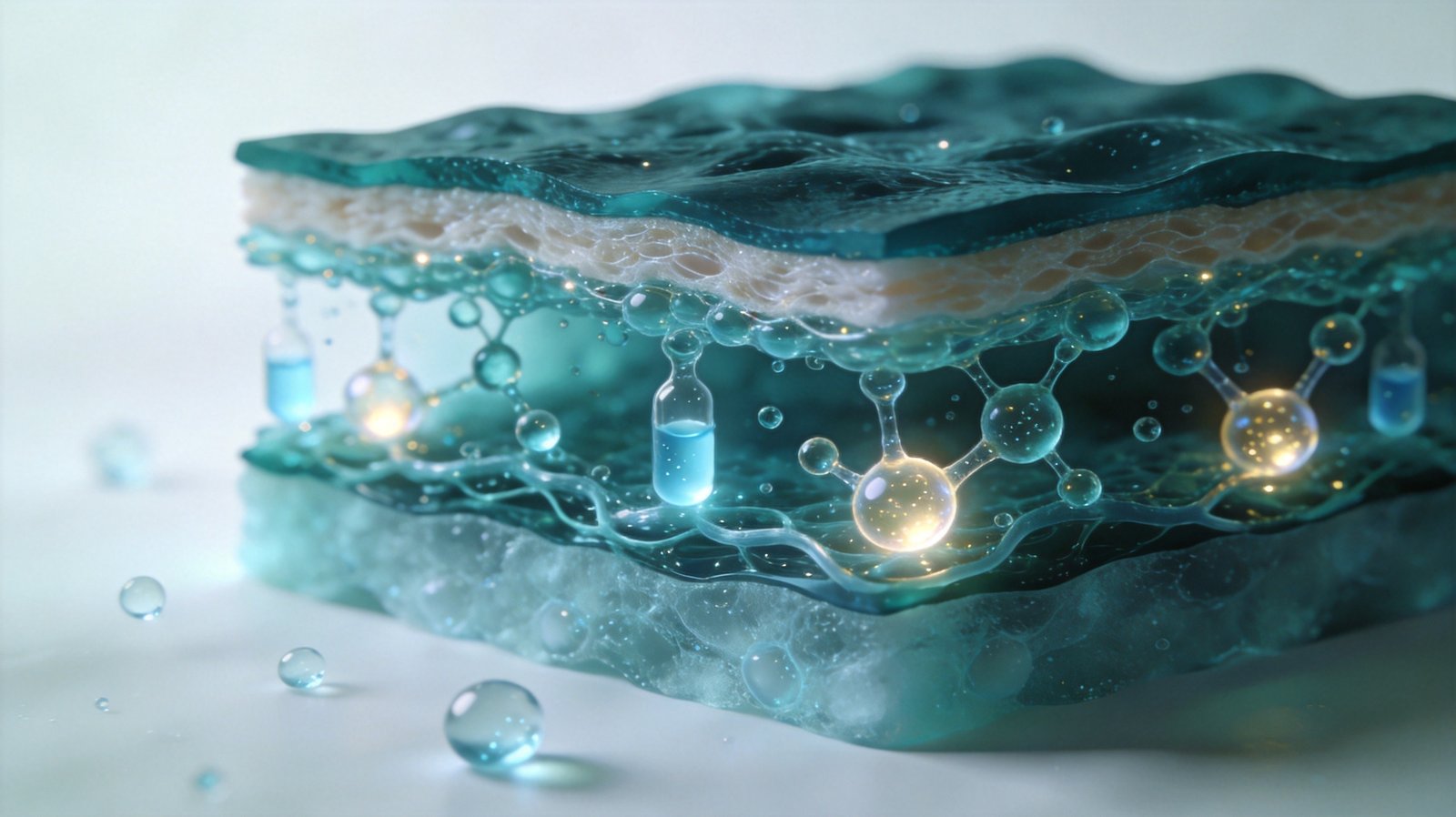
Q: What is the extracellular matrix (ECM)? A: The ECM is a three-dimensional network structure that exists between cells, secreted and assembled by cells, composed of collagen, elastin, glycosaminoglycan (including hyaluronic acid), and proteoglycan. In the skin, it accounts for about 80% of the dermal volume and is responsible for structural support, signal transduction, and tissue repair. It is the "life scaffold" that determines skin firmness, elasticity, and hydration.
Q: What is dECM and how is it made? A: dECM stands for decellularized extracellular matrix, a biomaterial obtained by removing cellular components from tissues through physical, chemical, or enzymatic methods while preserving the natural three-dimensional structure and active molecules such as collagen, elastin, and GAG. dECM retains a microenvironment close to that in vivo. In 2025, it accounted for 51.1% of the global ECM market (pmarketresearch), making it an important raw material direction for tissue repair and skin regeneration research.
Q: How does ECM relate to skin aging? A: The degradation and loss of ECM is the core mechanism of skin aging: MMP metalloproteinases break down collagen and elastin, oxidative stress causes damage, glycation makes collagen stiff and yellow, and the loss of hyaluronic acid leads to sagging, dryness, and dullness. In 2025, ECM was listed as the thirteenth hallmark of aging (36Kr report/academic framework). The anti-aging approach is shifting from "supplementing ingredients" to "repairing the ECM network."
Q: Collagen vs hyaluronic acid vs ECM — what's the difference? A: Collagen is the most abundant structural protein in the ECM, responsible for tensile strength; hyaluronic acid is a glycosaminoglycan in the ECM, responsible for water absorption, moisturizing, and maintaining volume; ECM is the complete three-dimensional system that includes both. Simply put: collagen is the "rebar," HA is the "reservoir," and ECM is the "entire building." Supplementing a single ingredient often treats the symptoms, while repairing the ECM network is the holistic view of anti-aging.
Q: Can ECM ingredients penetrate skin? A: Large-molecule ECM ingredients (such as intact collagen) have difficulty directly crossing the stratum corneum and mainly work through moisturizing, film-forming, and apparent firming; hydrolyzed small-molecule peptides and hyaluronic acid fragments can penetrate into deeper layers of the epidermis. Therefore, claims should distinguish between "surface action" and "penetration delivery." Formulations need to be designed with carrier technology, molecular weight, and transdermal evaluation to support real efficacy.
Q: Is ECM safe for cosmetics and aesthetics? A: Safe, but it depends on the source and process. ECM ingredients used in cosmetics, such as recombinant collagen, hydrolyzed peptides, and hyaluronic acid, must comply with ingredient standards and purity requirements; ECM materials used for injection fall under the regulation of medical devices/biomaterials and must undergo strict biocompatibility, sensitization, and sterility validation. Choosing qualified, compliant ingredient suppliers who can provide test reports is the prerequisite for safety.
Q: What is ECM injection? A: ECM injection refers to injectable materials based on decellularized matrix or recombinant ECM components, used for facial filling, tissue regeneration, and anti-aging repair. Unlike simple hyaluronic acid filling, ECM injection emphasizes "rebuilding the microenvironment and inducing self-tissue regeneration." It belongs to the direction of regenerative medicine aesthetics and is currently mostly filed through the Class III medical device pathway, being in the early stages of clinical application and industrialization.
Q: Which collagen type matters most (I, III, XVII)? A: Type I collagen is the most abundant structural protein in the skin, determining firmness and tensile strength; type III collagen is associated with tissue repair and youthfulness, with a high proportion in infant skin; type XVII collagen (COL17) is the "guard protein" of epidermal stem cells and has recently been confirmed to be closely related to stem cell maintenance and delaying aging. The three have different roles in the skin, and formulations should select the corresponding type and purity based on the target claim.
Q: How big are the ECM, collagen and HA markets? A: The global ECM market was approximately USD 2.15 billion in 2025 and is expected to reach USD 3.81 billion by 2032 (CAGR 8.5%, pmarketresearch); global collagen was approximately USD 5.85 billion in 2025 and is expected to reach USD 11.8 billion by 2035 (reportsanddata); recombinant collagen is growing fastest, at USD 4.12 billion in 2025 and expected to reach USD 23.84 billion by 2032 (CAGR 28.5%, pmarketresearch); HA dermal fillers were approximately USD 5.44 billion in 2025 (marketdataforecast); China's ECM product market was approximately RMB 10.7 billion in 2025.
Q: How to choose ECM / collagen raw material suppliers? A: A high-quality supplier should have three points: first, a recombinant expression system (such as yeast or E. coli expression of recombinant collagen) to ensure batch-consistent quality; second, comprehensive purity testing (HPLC, SDS-PAGE, etc.) and activity validation data; third, scaled production capacity and compliance documents (ingredient standards, test reports, stability data) that can support the brand's entire chain from sampling to mass production.
Q: What is the future of ECM in aesthetics? A: ECM is regarded as the next stop in regenerative aesthetics: ECM biomaterials are expected to grow from USD 400 million in 2025 to USD 920 million in 2035 (CAGR 8.3%, statifacts), and medical aesthetics applications account for 45% of recombinant collagen (pmarketresearch), indicating high growth in the sector. Future directions include ECM injectable materials, tissue-engineered skin, and personalized regeneration solutions. The key to industrialization remains raw material quality, compliance, and clinical validation.
Q: What causes ECM degradation? A: Three major mechanisms: MMP metalloproteinases are overexpressed under UV and inflammatory stimulation, breaking down collagen and elastin; free radicals generated by oxidative stress damage ECM macromolecules and inhibit new ECM synthesis; AGEs produced by glycation cause abnormal collagen cross-linking, stiffness, and yellowing. In addition, age-related decline in fibroblast synthesis capacity and accelerated hyaluronic acid breakdown together cause net ECM loss.
Q: What is ECM skincare? A: ECM skincare refers to the skincare direction aimed at repairing or supplementing extracellular matrix components. Common ingredients include recombinant collagen, collagen peptides, hyaluronic acid, proteoglycan, and dECM extracts. The logic is: by supplementing key ECM components, inhibiting MMP degradation, and promoting fibroblast synthesis, it helps the skin rebuild a healthy "structure-signal" network, achieving firmness, elasticity, and repair.
Q: Are ECM and collagen the same thing? A: No. Collagen is the most abundant component of the ECM, a "part"; ECM is the complete system including collagen, elastin, glycosaminoglycan, proteoglycan, etc., the "whole machine." When discussing efficacy, claiming "contains collagen" points to a single ingredient, while claiming "ECM repair" points to overall network reconstruction. The two act at different levels and cannot be conflated.
About Weitai Group
Weitai Group is a biotechnology company focused on collagen and ECM biological raw materials and medical-aesthetic-grade cosmetics OEM: its velubio.com supplies collagen/ECM biological raw materials globally (36-language international site), and its zhenmeifu.com provides cosmetics OEM/ODM services, covering medical masks and collagen products. With an integrated model of "raw material R&D + finished product OEM," we provide global brands with complete solutions from ingredient selection and formula development to finished product launch.
Further reading: To learn more about collagen and ECM raw materials, please visit Velubio; for one-stop cosmetics and medical aesthetics OEM services, please visit Zhenmeifu.