
I. What Is the Extracellular Matrix (ECM)?
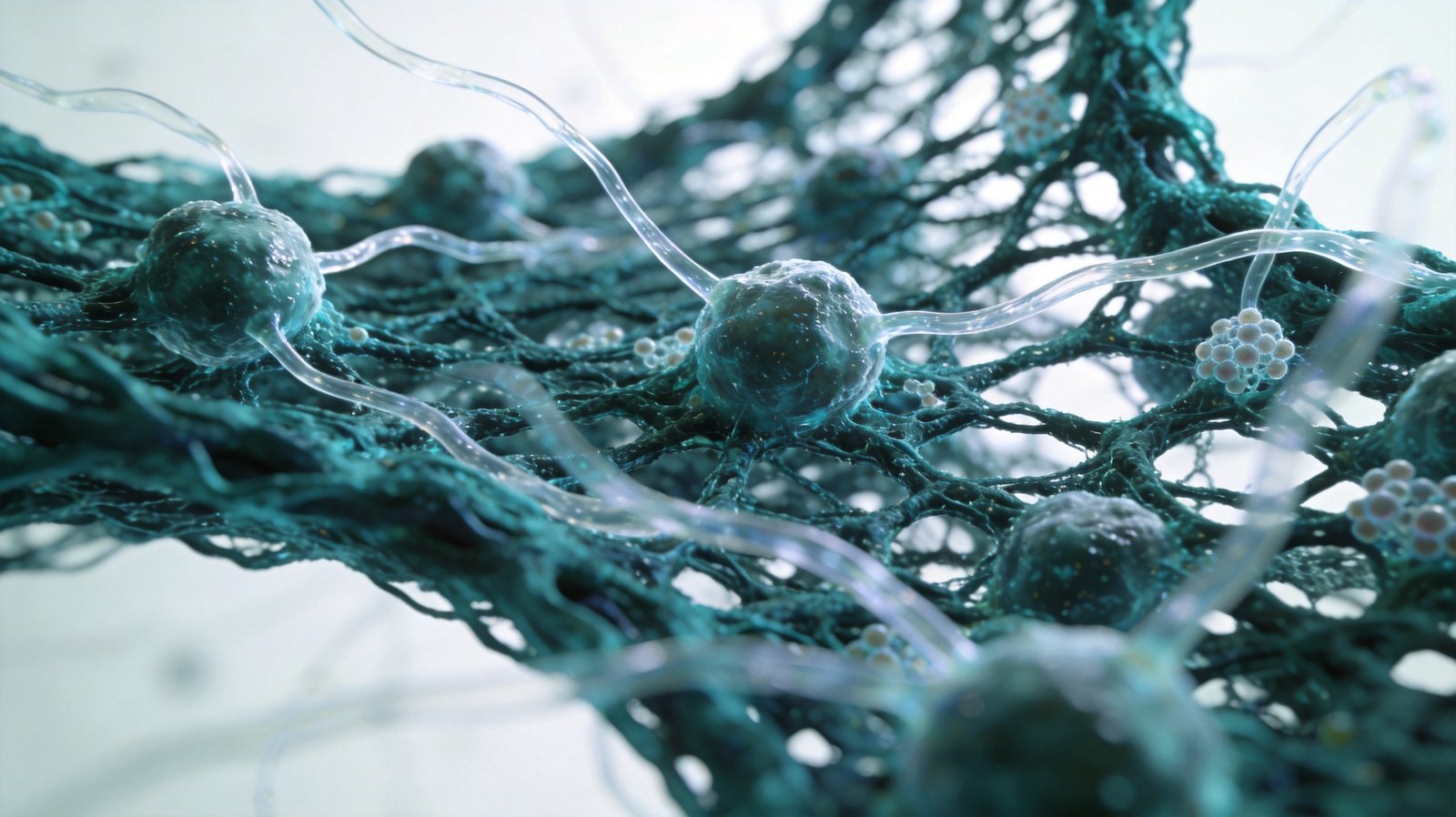
The ECM, short for extracellular matrix, is a three-dimensional reticular "scaffold" that exists between all tissue cells, secreted and assembled by cells. It is not merely a filler, but an active microenvironment that simultaneously provides structural support, signal transduction, nutrient exchange, and tissue repair.
In the skin, the ECM accounts for approximately 80% of the dermal volume, weaving fibroblasts, blood vessels, and immune cells together. The firmness, fullness, elasticity, and hydration of the skin are essentially the external manifestation of the ECM state—when the ECM is healthy, the skin is youthful; when the ECM collapses, the skin ages. This also explains the underlying logic behind the rapid rise of the ECM skincare concept in recent years: the target of anti-aging skincare is shifting from "supplementing a single ingredient" to "repairing the entire extracellular matrix network."
II. The Four Building Blocks of the ECM
The skin ECM is mainly composed of four major categories of biological macromolecules, each with its own role yet working in synergy:
1. Collagen—the most abundant structural protein in the ECM, accounting for more than 70% of the skin's dry weight, and the "rebar" of the dermis. Type I collagen provides tensile strength and determines skin firmness; Type III collagen is associated with repair and regeneration and is present at a higher proportion in young skin. The density and cross-linking quality of ECM collagen directly determine whether the skin can "hold up."
2. Elastin—the "rubber band" that gives the skin its rebound ability. Elastin fibers cross-link into a network, allowing the skin to return to its original state after compression. It is mainly synthesized in early years, and its regenerative capacity is extremely weak after adulthood—this is one of the reasons why sagging is difficult to reverse once it appears.
3. Glycosaminoglycan (GAG) and Hyaluronic Acid (HA)—highly hydrophilic polysaccharide chains, the "reservoir" of the ECM. GAGs, represented by hyaluronic acid, can bind more than a thousand times their own weight in water, maintaining skin hydration and volume. The loss of HA is one of the direct causes of dry and deflated skin.
4. Proteoglycans—complexes formed by core proteins linked to GAG chains, such as versican and decorin. They not only "lock in water" but also serve as "signal stations" for cytokines and growth factors, regulating cell proliferation, migration, and ECM remodeling.
| Overview of Major Skin ECM Components and Functions | ||
|---|---|---|
| Component | Characteristics | Core Function |
| Type I collagen | More than 70% of dermal dry weight | Tensile strength, determines firmness |
| Type III collagen | Higher proportion in young skin | Repair and regeneration, maintains elastic texture |
| Elastin | Cross-linked fibrous network | Rebound and anti-sagging |
| Hyaluronic acid (GAG) | Can bind 1,000 times its weight in water | Moisturizing, maintains volume and fullness |
| Proteoglycans (e.g., decorin) | Protein + GAG complex | Water retention + growth factor signal regulation |
III. How ECM Degrades with Age
Starting around age 25, the "synthesis-degradation" balance of the skin ECM continuously becomes imbalanced, with the rate of loss gradually exceeding regeneration. This extracellular matrix aging is driven by three main pathways:
1. MMP metalloproteinase degradation. Matrix metalloproteinases (MMP-1, MMP-3, MMP-9, etc.) are the "demolition crew" of the ECM. Stimuli such as ultraviolet radiation and inflammation upregulate MMP expression, cutting collagen and elastin into fragments. With age, the soluble collagen content in the skin decreases while MMP activity increases, and collagen fibers transform from a "dense network" into a "fragmented network."
2. Oxidative stress. Reactive oxygen species (ROS) attack ECM macromolecules, causing oxidative damage to collagen and elastin, while inhibiting fibroblasts from synthesizing new ECM, forming a vicious cycle of "damage-degradation-further damage."
3. Glycation (AGEs). Reducing sugars undergo non-enzymatic glycation with collagen, forming advanced glycation end products (AGEs). Glycated collagen loses flexibility, cross-links abnormally, and turns yellow, manifesting as stiffness, dullness, and loss of elasticity in the skin; AGEs also "lock" ECM degradation sites, interfering with normal remodeling.
In addition, hyaluronic acid synthesis significantly declines with age and its decomposition accelerates, and the ability of fibroblasts to secrete ECM greatly diminishes after "aging." Under the combined effect, the dermis thins, collagen breaks down, the elastic network fragments, and hydration capacity declines—this is the truth of aging at the tissue level.
IV. 2025: ECM Listed as the "Thirteenth Hallmark of Aging"
In 2023, the authoritative aging research framework proposed the "Twelve Hallmarks of Aging" in Cell; in 2025, the framework was officially expanded to list the ECM as the Thirteenth Hallmark of Aging (according to 36Kr reports and academic framework updates). This milestone means that the scientific community has, for the first time, elevated "extracellular matrix network imbalance" to the same level as core aging mechanisms such as genomic instability, telomere attrition, and epigenetic alterations.
The establishment of its hallmark status brings three layers of impact: first, the ECM becomes a "legitimized" main battlefield for anti-aging research; second, it promotes "holistic ECM repair" replacing "single-ingredient supplementation" as a new paradigm for formulation design; third, it brings natural-source ECM ingredients such as dECM (decellularized ECM) into the视野 of cosmetics and medical aesthetics—by removing cellular components while preserving the intact three-dimensional structure and active molecules, dECM becomes a candidate solution for reconstructing a youthful microenvironment in vitro.
V. Why Both Cosmetics and Medical Aesthetics Are Targeting the ECM
The industrial heat of the ECM has clear data support:
- The global ECM market was approximately USD 2.15 billion in 2025, projected to reach USD 3.81 billion by 2032, with a CAGR of 8.5%; among this, dECM accounts for 51.1% of the ECM market share (pmarketresearch).
- ECM biomaterials were approximately USD 400 million in 2025, projected to reach USD 920 million by 2035, with a CAGR of 8.3% (statifacts).
- Recombinant collagen was approximately USD 4.12 billion in 2025, projected to reach USD 23.84 billion by 2032, with a CAGR of 28.5%, of which medical aesthetics applications account for 45% (pmarketresearch).
- Global collagen was approximately USD 5.85 billion in 2025, projected to reach USD 11.8 billion by 2035, with a CAGR of 7.3% (reportsanddata).
- Hyaluronic acid dermal fillers were approximately USD 5.44 billion in 2025, projected to reach USD 11 billion by 2034, with a CAGR of 8.14% (marketdataforecast).
- China's ECM product market was approximately RMB 10.7 billion in 2025 (cross-validated across multiple industry sources).
Industry players are also making intensive moves: leading medical aesthetics companies are entering with humanized biomimetic ECM and ECM collagen injectable materials. For brands and OEM clients, this means that "ECM" is transforming from a scientific term into a registrable, claimable, and mass-producible formulation asset—whoever establishes an ECM ingredient and finished product system first will secure a differentiated position for the next five years.
VI. Key Takeaways
- The ECM is the skin's "structural scaffold + signaling network," and firmness, elasticity, and hydration are all its external manifestations.
- The four major components—collagen, elastin, GAG/HA, and proteoglycans—synergistically support youthful skin.
- MMP degradation, oxidative stress, and glycation attack from three directions, causing irreversible ECM loss with age.
- In 2025, the ECM was elevated to the thirteenth hallmark of aging, shifting the anti-aging narrative from "supplementing ingredients" to "repairing the network."
- The high growth rates of the global ECM market at a CAGR of 8.5% and recombinant collagen at 28.5% indicate that a new round of ingredient upgrading in cosmetics and medical aesthetics has already begun.
For formulation and procurement decision-makers, understanding the composition and degradation mechanisms of the ECM is the starting point for evaluating "ECM-type ingredients and claims"; choosing an ingredient partner with a recombinant expression system, purity testing, and large-scale production capacity is the key step to turning the concept into a product.
Further Reading: To learn more about collagen and ECM ingredient information, please visit Velubio; for one-stop cosmetics and medical aesthetics OEM services, please visit Zhenmeifu.